


Port Angeles cannot compassion its way out of homelessness if compassion means tolerating suffering, addiction, fires, human waste, environmental damage, and business disruption. Real compassion must include housing, treatment, outreach, and support, but also boundaries, accountability, enforcement of laws against harmful conduct, and protection of businesses, neighborhoods, workers, parks, creeks, and shared public spaces. The City Council has taken steps, and I believe its members are trying to respond in good faith. But in my view, Council has appeared more comfortable studying services than directly confronting the harder questions of priority zones, enforcement expectations, and public-space accountability.
A personal note before I begin
Over the past several weeks, I have been spending a lot of time thinking, reading, listening, and talking about homelessness in Port Angeles.
The previous three articles I wrote on this topic focused largely on interviews with people in our community who are close to the issue. Those conversations were valuable, and they shaped a lot of my thinking. This article is different.
This is an opinion piece.
It is informed by those interviews, by hours of research, and by even more hours listening to City Council meetings. It is also informed by nearly 20 years of proximity to a close family member who has been in the throws of addiction. But the conclusions here are mine. I am not speaking for the people I interviewed, and this article should not be read as an endorsement from them or as a summary of their positions. I am grateful for their time, their work, and their willingness to share their perspectives, but I am responsible for the opinions and judgments that follow.
This article is written from my heart, with respect for the people doing hard work, compassion for those who are suffering, and concern for the places where I believe we are still falling short.
There are moments when a community has to say two things at the same time.
First, people who are homeless are human beings. They are our neighbors, our family members, our former classmates, our coworkers, our veterans, our elderly, our disabled, and in some cases people who have simply run out of options in a housing market that has become impossible for them.
Second, what we are currently allowing in parts of Port Angeles is not compassionate.
It is not compassionate to allow people to live in tents, ravines, creek beds, doorways, and broken-down vehicles while addiction and untreated mental illness consume them. It is not compassionate to allow people to deteriorate in public view until police, fire, outreach workers, business owners, volunteers, and city staff are left responding to the same preventable crisis over and over again. It is not compassionate to pretend that open-air drug use, fires, human waste, needles, theft, threats, environmental damage, and business disruption are simply unfortunate side effects of a housing shortage.
They are signs that our response is not yet serious enough.
And that is the distinction I hope we can make with honesty and care. This is not about vilifying people who are homeless. It is about refusing to confuse compassion with avoidance. Real compassion does not look away from suffering, and it does not ask the broader community to quietly absorb the consequences of systems that are not working.
Real compassion requires housing, treatment, outreach, and support.
It also requires boundaries, accountability, and protection of the public spaces we all share.
“It is not ever our job to prevent people from experiencing consequences of decisions that they’ve made. It’s our job sometimes to walk beside people while they manage those consequences.”
That balance is difficult. It is also necessary.
The public often sees the visible crisis first: the tents, the trash, the drug use, the damaged restrooms, the fires, the threats, the business disruption. The people doing the daily work often see a deeper human story underneath it: trauma, addiction, mental illness, poverty, disability, isolation, and a housing market that leaves too many people with nowhere to go.
Both perspectives are real.
The challenge before Port Angeles is to honor the humanity of those living outside without denying the harm that is happening around them. That begins with acknowledging a simple truth: homelessness is not one problem.
Homelessness is not one problem
One of the biggest mistakes we make is talking about homelessness as if it is one issue with one cause and one solution.
It is not.
Some people in our community are primarily experiencing a housing crisis. They lost a job. They lost a relationship. Rent went up. A medical bill hit. A landlord sold the house. A family member could no longer take them in. A senior on a fixed income got priced out. A person fled domestic violence. Some people are working and still cannot find a place they can afford.
That group needs fast, flexible housing help. Rental assistance. Utility relief. Landlord mediation. Home sharing. Workforce housing. Rapid rehousing. More housing that people with ordinary wages can actually afford. The goal should be to keep them from ever becoming chronically homeless.
A second group is stability-ready or recovery-ready. These are people who may need structure, sober housing, work opportunities, life skills, mentoring, and a place to rebuild. They may not be ready for a traditional apartment tomorrow, but they are ready to take steps. This is where programs like 4PA’s Touchstone Campus can play an important role. Touchstone is being designed as a high-barrier, transitional setting with clear expectations, no drugs or alcohol, caseworker support, job opportunities, common facilities, and a goal of helping people move toward self-sustainability.
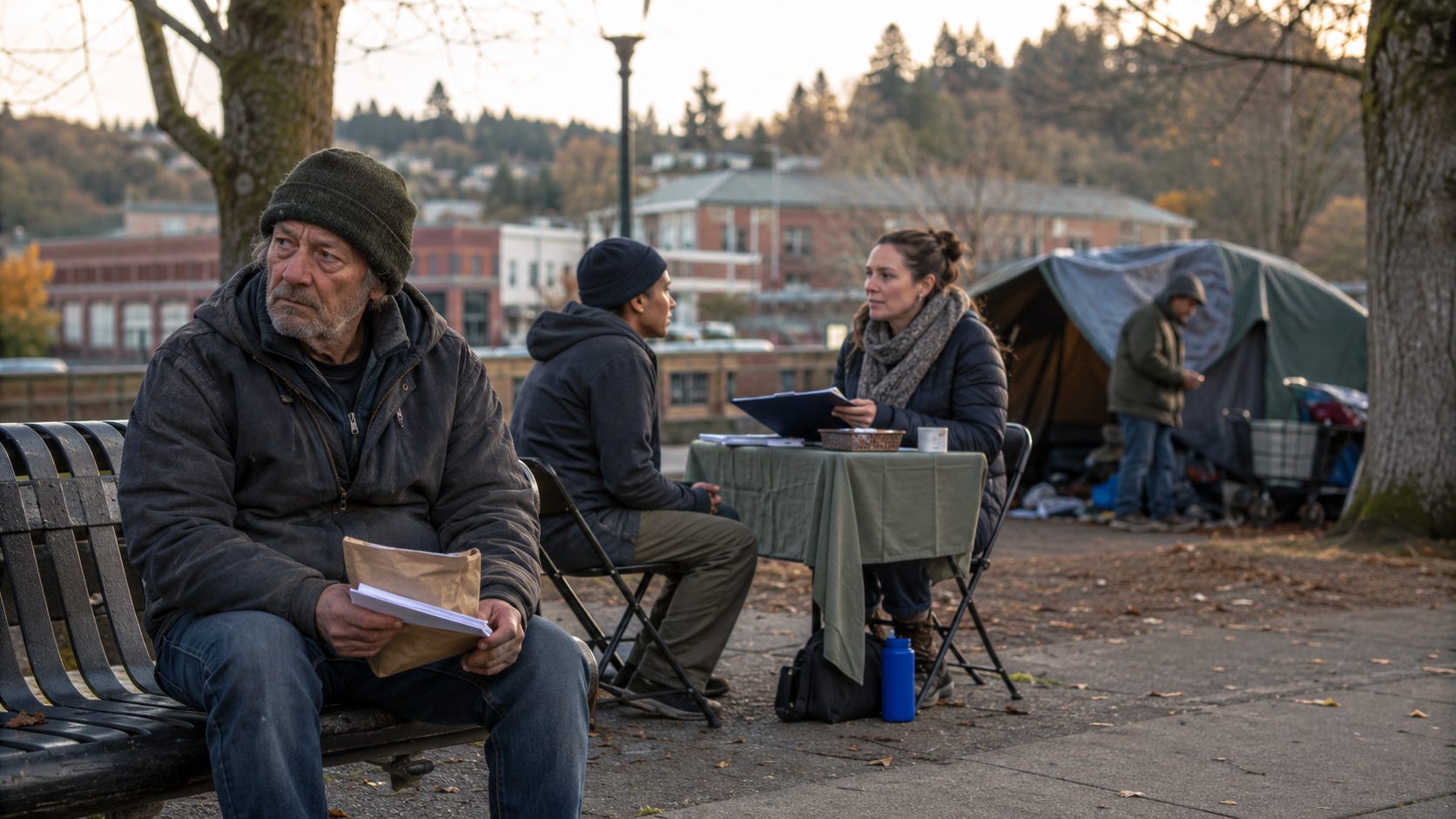
Then there is the group that is the hardest to talk about, but the one we most need to talk about honestly.
These are people who are chronically unsheltered, deeply addicted, severely mentally ill, cognitively impaired, traumatized, or some combination of those things. Not everyone in this group is causing harm. That needs to be said clearly. But much of the visible public disorder, environmental damage, repeated cleanup, and business disruption appears to come from a smaller high-impact group.
This group is not primarily facing a simple housing problem. They are facing a combined housing, behavioral-health, addiction, public-safety, and public-space crisis.
That requires a different response.
And it is around this third group that much of the community’s frustration, fear, compassion, anger, and confusion begins to collide.
What people are seeing is real
Many residents are frustrated, and they are not wrong to be frustrated.
They see tents and debris in public spaces. They see people using drugs in the open. They hear about fires in sensitive areas that the fire department has to put out. They see human waste and garbage. They see needles and harm-reduction supplies discarded in places where children, pets, workers, and volunteers may encounter them. They see damage around Tumwater Creek, a salmon-bearing waterway that should be treated as an environmental priority, not a dumping ground.
They also see businesses adapting in ways that should make all of us pause.
Safeway is a visible example. Anyone who shops there has noticed the automatic gate at the entrance and the fact that the only way out is through the cashier area. Some people have reacted negatively to that. I see it differently. I see a local business making a difficult choice to protect its employees, customers, inventory, and business interests because broader local and state policies have failed to advocate for businesses directly enough.
Businesses should not have to redesign the customer experience around theft and disorder. Employees should not have to clean up human waste, drug debris, and trash left behind in alcoves or against buildings. Property owners should not have to wonder whether evidence of a small fire against a building is the warning sign before something worse.
A city that values compassion should also value the people trying to keep their doors open, keep employees safe, and maintain welcoming places for customers. When businesses are forced to absorb the daily cost of disorder, that is not just a private inconvenience. It is a public-policy failure. Protecting local businesses is not anti-homeless. It is pro-community.
Downtown Port Angeles is not an abstraction. The Waterfront District includes about 252 businesses, more than 50 retail shops, more than 40 restaurants, and hundreds of residents. It is one of the densest commercial areas on the Olympic Peninsula and a major gateway for the community. When the Waterfront District asks the City to take safety, lighting, visibility, cleanliness, and public-space design seriously, that should not be treated as a side concern. It should be central.
The same is true for 4PA’s work.
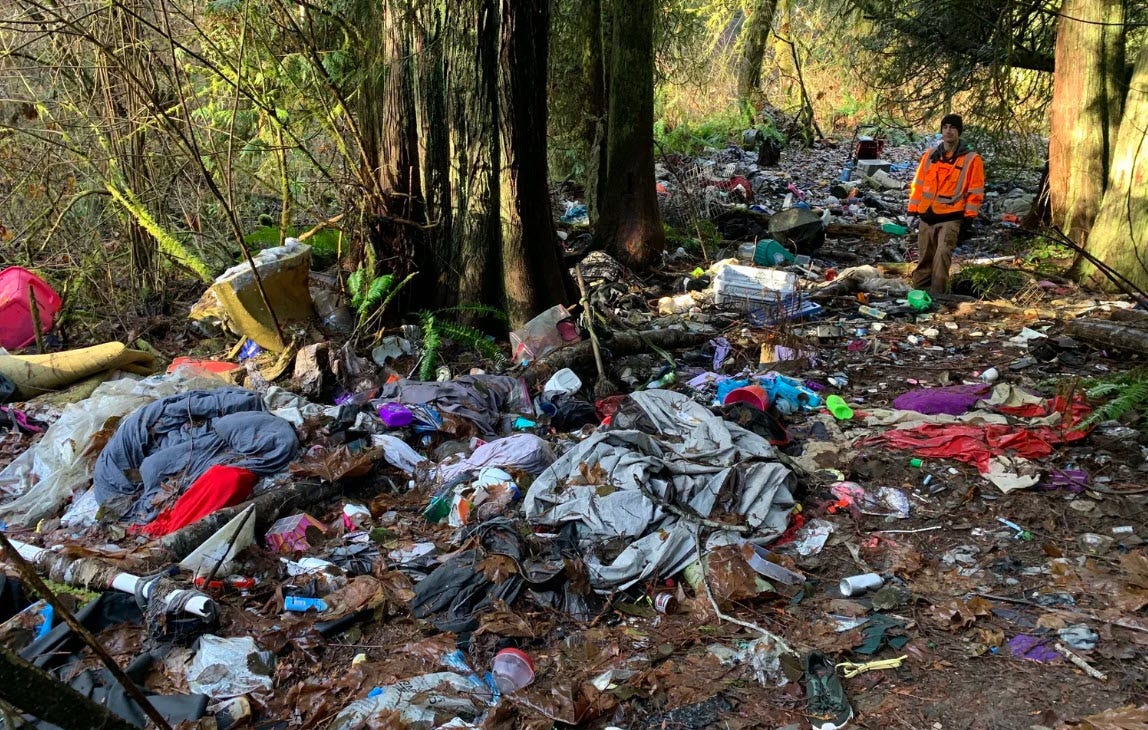
Since 4PA began in 2021, the organization reports removing 437,830 pounds of waste from our community, much of it around sensitive environmental sites. They also report removing 34,376 needles in that time.
Those numbers are staggering.
They also raise an uncomfortable question: if 4PA was not doing this work, what would Port Angeles look like right now?
Would Tumwater Creek be passable? Would some of our public spaces be usable? Would the problem be easier to ignore, or impossible to deny?
The fact that one nonprofit and its volunteers are removing hundreds of thousands of pounds of waste is not proof that the system is working. It is proof that extraordinary community effort is preventing a deeper visible failure.
And that visible failure is not limited to creek beds, alleys, and encampments. It is also showing up in the public infrastructure we ask everyone to share.
Restrooms are a dignity issue, but restroom abuse tells us something
I believe people need access to restrooms. That is a basic issue of human dignity and public health.
But we also have to be honest about what City staff described during recent Council discussions. Public restrooms are being used for vandalism, drug use, garbage, and other activity that creates daily hazardous conditions for employees. Staff reported that needles and clothing are often flushed, forcing toilets to be removed to clear obstructions. The City has spent nearly half a million dollars cleaning outdoor restrooms since 2023.
That number should change the conversation.
Beyond the public cost, there is also a serious worker-safety and financial-risk concern. If City employees are being sent into restrooms with known needle, drug-waste, and biohazard risks, the City has an obligation to treat that as a workplace hazard, not routine maintenance. If employees have repeatedly raised these risks and contracts a disease from a dirty needle it may create avoidable legal, safety, and financial exposure through workers’ compensation, investigations, penalties, legal costs, and long-term medical concerns. Known hazards do not become less expensive when they are ignored.
A restroom is not a homelessness solution. A trash can is not a homelessness solution. Both may be necessary, but if we add public infrastructure without staffing, security, maintenance, accountability, and clear rules, we are not solving the problem. We are expanding the burden.
It is perfectly reasonable to say that people need bathrooms.
It is also reasonable to say that bathrooms cannot become unmanaged drug-use sites, encampment extensions, or hazardous workplaces for City employees.
Both things can be true.
This points to a larger issue. Too often, the public conversation gets reduced to a narrow question: “Are people committing crimes, or are they just homeless?” But residents and businesses are often reacting to something that sits in between those categories. They are reacting to public spaces that feel less usable, less clean, less predictable, and less cared for.
That does not always show up clearly in a crime report.
So before we use crime statistics to prove too much, we should be honest about both what they show and what they miss.
The crime statistics are useful, but they do not tell the whole story
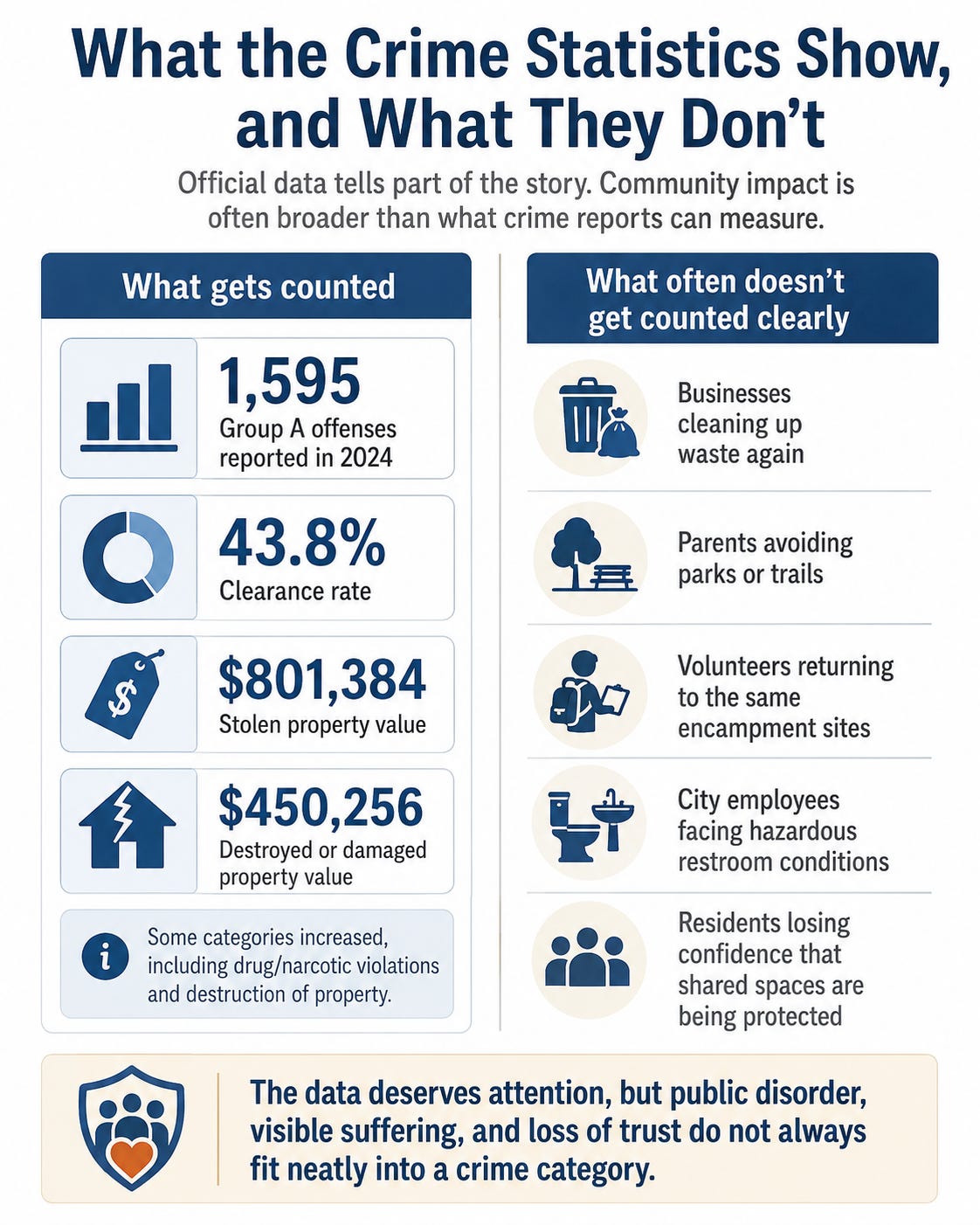
The 2024 Port Angeles Police Department statistics are worth paying attention to. They show 1,595 Group A offenses, a 43.8 percent clearance rate, $801,384 in stolen property, and $450,256 in destroyed or damaged property. The report also shows increases in some categories, including drug/narcotic violations and destruction of property.
Those numbers are important, but we need to be careful about what we ask them to prove.
It would be wrong, unfair, and unsupported to say that people experiencing homelessness are causing all the crime in Port Angeles. Many people who are homeless are not committing serious crimes. Many are victims themselves. Many are trying to survive, trying to get back into housing, working, staying connected to services, or doing everything asked of them while still unable to find a place they can afford.
At the same time, avoiding unfair blame should not require us to ignore the public impacts residents are seeing. It should also not make us afraid to say that laws against theft, assault, trespass, vandalism, illegal dumping, drug dealing, fires, and threats still need to be enforced. Some harms show up clearly in crime statistics: theft, assault, property damage, drug violations, and vandalism. Others are harder to count: a business owner cleaning up waste again, a parent avoiding a park, a volunteer returning to the same encampment site week after week, a City employee facing hazardous restroom conditions, or a resident slowly losing confidence that shared spaces are being protected.
That is the gap we need to talk about honestly.
A community can be statistically “safe” and still feel like it is losing control of its shared spaces. Not because everyone living outside is dangerous. Not because every concern should be treated as a criminal issue. But because repeated disorder, visible suffering, and unmanaged public impacts can wear down trust even when they do not fit neatly into a crime category.
That is why the next part of the conversation has to move beyond blame and beyond slogans. We need to look carefully at the tools being offered and ask whether they fit the problem we are actually trying to solve.
Housing First is not a slogan that ends every discussion
There is a reason Housing First and permanent supportive housing are part of homelessness policy. For people who are chronically homeless and disabled, permanent supportive housing can help them stay housed. The National Academies found that permanent supportive housing improves housing stability for many people experiencing chronic homelessness, while also noting that evidence is more limited or mixed on broader health outcomes and cost offsets.
That nuance is essential.
“The question is not whether a tool is good or bad. The question is whether it fits the problem in front of us.”
Housing First should not be used as a slogan to shut down every concern about behavior. Housing First is a housing stability model. It does not eliminate the need for treatment access, case management, public safety, sanitation, environmental cleanup, or consequences for harmful conduct.
A roof can help stabilize someone. But a roof alone does not cure addiction. It does not automatically treat psychosis. It does not repair trauma. It does not teach life skills. It does not rebuild a healthy social network. It does not make someone ready to be a good neighbor. It does not, by itself, protect a creek, a business district, or a public restroom.
Housing is a tool. It is often a vital one. But no tool works in every situation.
A hammer is useful when you need a hammer. Used on the wrong problem, it just breaks things.
The same is true of harm reduction. It is often discussed as if a person must either support it completely or reject it completely. I do not think that is honest enough.
Harm reduction can save lives, but it is not a complete public-order strategy
This is another area where our conversation needs more honesty and less shouting.
Syringe service programs and related harm-reduction efforts can reduce disease transmission, connect people to care, and reduce overdose risk. CDC says comprehensive syringe services programs are safe, effective, cost-saving, and do not increase illegal drug use or crime.
That should be taken seriously.
But harm reduction is not a full homelessness or addiction strategy. It does not, by itself, solve encampments, theft, fires, human waste, intimidation, environmental damage, business disruption, or all health related impacts of drug use.
When harm-reduction supplies end up littered throughout the community, that creates frustration for good reason. A person can support disease prevention and still object to needles, foil, pipes, wrappers, and other supplies being left in parks, alleys, creek beds, sidewalks, and business entries.
The answer is not to pretend the litter is acceptable.
The answer is to make harm reduction more accountable, more connected to treatment, and more responsible to the broader community.
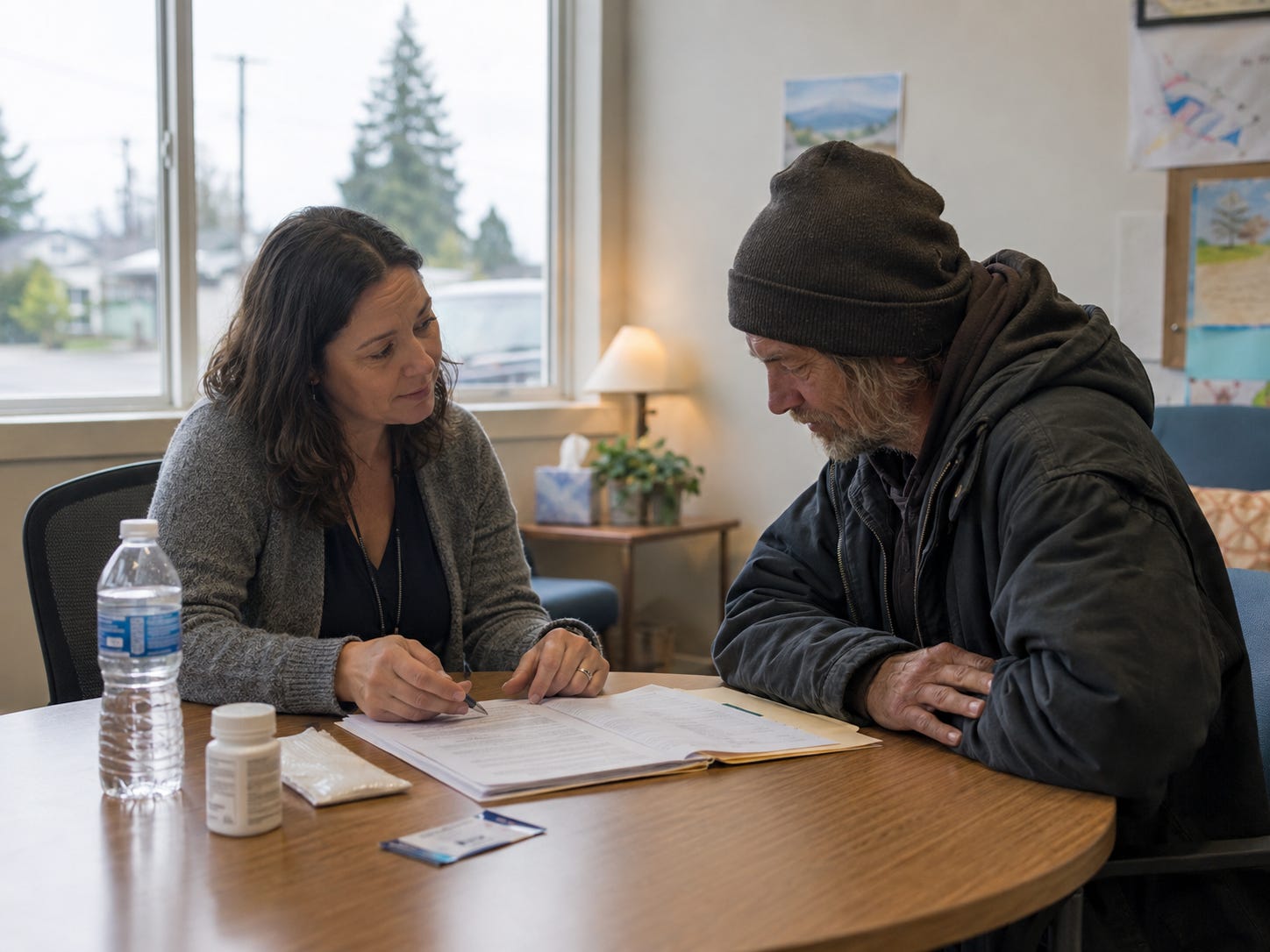
Medication treatment is a bridge, not the destination
Medication treatment for opioid addiction is another important tool.
Methadone, buprenorphine, and naltrexone can reduce cravings, prevent withdrawal, and lower overdose risk. CDC guidance says medication treatment for opioid use disorder is associated with reduced overdose risk and reduced overall mortality, and that detoxification alone is not recommended because of the risk of returning to use, overdose, and death.
That is a strong argument for medication treatment.
It is not an argument for medication treatment alone.
Medication can help stabilize a person. It can give someone enough breathing room to stop chasing fentanyl just to avoid being sick. It can reduce death. That is a major victory.
But it does not automatically create a productive life. It does not provide housing, employment, counseling, sober community, family repair, accountability, or purpose. It does not by itself address stimulant use, which is an increasing challenge in many communities.
Medication may be part of the bridge from addiction to recovery.
But the bridge still has to lead somewhere.
That “somewhere” should include treatment, aftercare, peer support, housing, work, structure, and a different environment. Without those next steps, people can remain stuck in a revolving door, safer than before perhaps, but still not truly well.
This is why temporary sheltering, safe parking, and sanctioned camping need to be evaluated with the same question in mind: are they part of a path forward, or are they simply a place to keep people in crisis?
Managed sheltering is only defensible if it is actually managed
The City Council has been considering managed sheltering concepts, including sanctioned encampments and safe parking. I do not think those ideas should be rejected out of hand.
A safe parking site can be helpful for someone living in a vehicle who can follow rules, work with a case manager, and move toward stability.
“A managed site must be more than a place where tents are allowed. It must be a path toward safety, treatment, stability, and housing. Without that path, it is not a bridge. It is containment.”
A sanctioned camping area could, in theory, reduce scattered camping, create a consistent point of contact for outreach, and give the City more legitimacy when saying, “You cannot camp here.”
But those ideas only work if they are truly managed.
That means staffing. Rules. Sanitation. Fire restrictions. Security. Case management. Outreach access. Data tracking. Time limits. Clear expectations. Enforcement of site rules. A response plan for drug activity, violence, theft, waste, fires, weapons, exploitation, and neighborhood impacts. A path out.
Without that, a sanctioned encampment risks becoming a publicly approved place for people to remain sick, addicted, unsafe, and out of sight. Our very own Skid Row.
That is not compassion.
It is containment.
And if we concentrate a vulnerable and unhealthy population without strong management, we should not be surprised if drug trafficking, exploitation, disorder, and environmental damage follow. Local conversations repeatedly return to this same theme: safe sites may have value, but only if they are highly managed, tied to a broader strategy, and not treated as the end point.
A managed site must be a bridge.
It cannot become the destination.
That brings us back to the hardest group, the people for whom a bathroom, a tent site, a bus pass, a pamphlet, or a one-time offer of help will not be enough.
The hardest cases need more than referrals
A person living in a tent, using fentanyl, experiencing paranoia, losing track of time, and trying to survive day to day is not likely to navigate appointments, paperwork, housing applications, treatment intake, transportation, and follow-up on their own.
That does not mean they are beyond help.
It means the help has to match the condition.
This is where Port Angeles needs to think less in terms of isolated services and more in terms of a coordinated pathway. Outreach should be persistent. Treatment should be accessible. Medication for opioid addiction should be available, but tied to counseling, recovery support, housing, and aftercare. Mental-health response should go to people who cannot reliably come to an office. And when harmful behavior crosses a line, there should be accountability, whether that is an arrest or a diversion that connects people to help while still making clear that theft, threats, fires, vandalism, waste, and environmental damage cannot simply continue.
“If you don’t help people have a plan for not just going back to hang out with the same people, and if you don’t have a plan for not just doing what you did before, then most of us do what we did before.”
And to be fair, much of this is already happening, at least to some degree. It has been genuinely encouraging to hear different groups and agencies working together toward common solutions.
And still, none of these tools answers everything.
Housing does not cure addiction by itself. Medication treatment does not create a whole life by itself. Harm reduction does not solve addiction or encampments by itself. Enforcement does not rebuild people by itself. Managed sheltering does not become compassionate just because we call it managed.
But used together, in the right order and with the right expectations, these tools can form a path that is more honest than either punishment alone or support without boundaries.
That is the kind of strategy Port Angeles needs.
And that is why the recent direction from City Council deserves both respect and scrutiny.
Council has taken steps, but the hardest questions remain
I want to be careful here, because respect is important.
Our City Council members are public servants. They are trying to respond to a difficult problem with limited resources, limited legal authority, limited staff capacity, and strong opinions coming from every direction. I do not believe they are indifferent. I do not believe they are acting in bad faith.
I also believe they are missing the hardest part.
In recent meetings, Council appeared more comfortable studying managed sheltering, restrooms, trash cans, non-law-enforcement behavioral-health response, and public-facing procedures than directly clarifying priority zones, enforcement expectations, and public-space accountability.
Some of what Council is doing has value. A public-facing encampment response procedure is a good idea. Better coordination is a good idea. Studying behavioral-health response is a good idea. Understanding restroom and trash needs is a good idea. Seeking proposals from capable organizations may be useful.
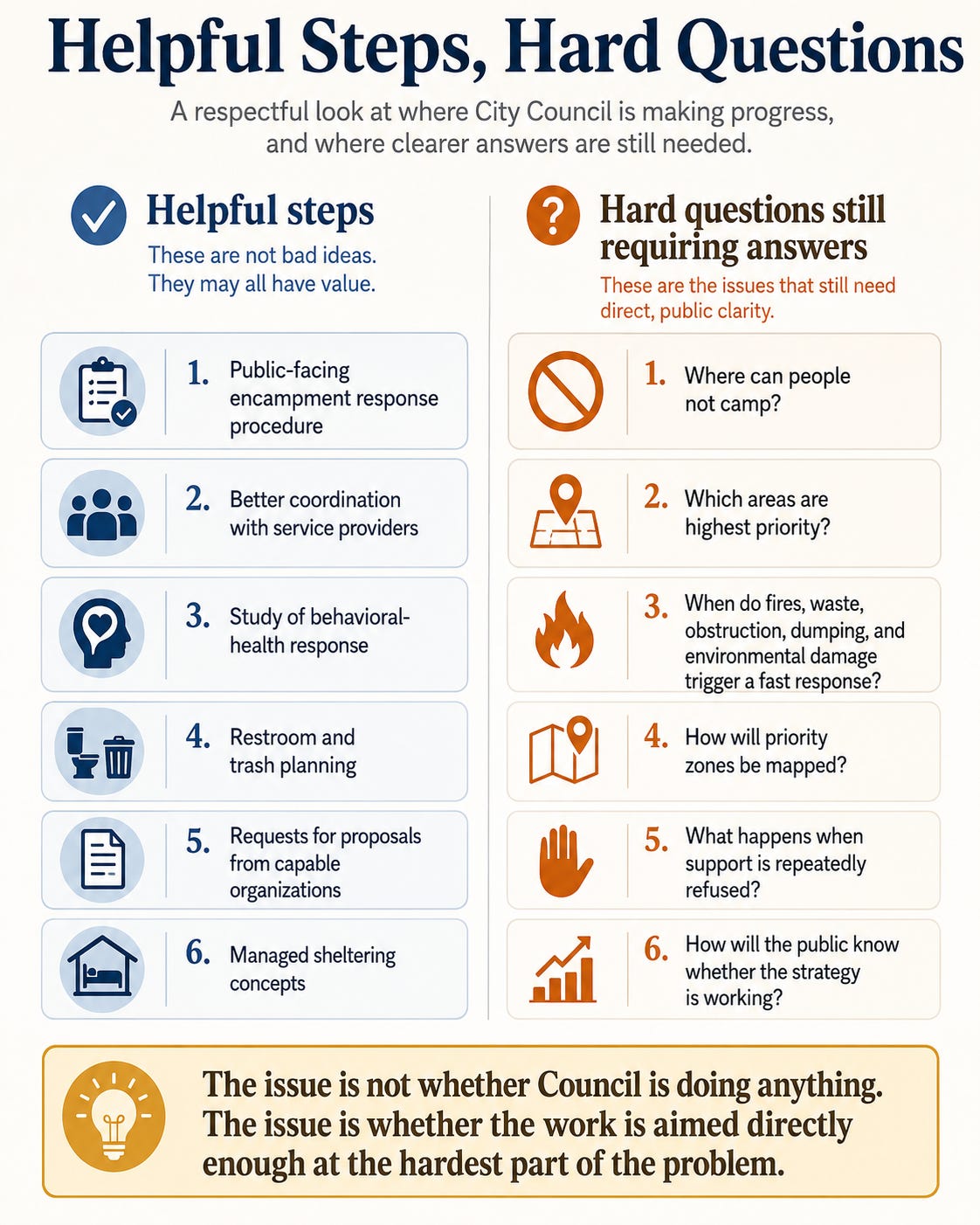
But the harder questions are these:
Where can people not camp?
Where will fires, waste, drug use, obstruction, dumping, and environmental damage trigger a fast response?
Which areas are highest priority?
Tumwater Creek? Peabody Creek? The Waterfront District? Downtown business corridors? Parks? Trails? Public restrooms? Schools? Ravines and bluffs? Sensitive shoreline areas?
If everything is a priority, nothing is.
One of the clearest misses came when a proposal to identify and map priority zones and pair them with a focused enforcement strategy did not move forward. That idea should not have been controversial. Mapping priority zones does not criminalize homelessness. It tells the public, staff, service providers, outreach workers, and people living outside where the City’s highest obligations are.
A salmon-bearing creek should be a priority zone.
A downtown business corridor should be a priority zone.
A public restroom repeatedly damaged by misuse should be a priority zone.
A park used by children should be a priority zone.
The City cannot solve every part of homelessness. But it can protect public spaces. It can define expectations. It can act faster in high-impact areas. It can stop letting the perfect become the enemy of progress.
Those questions became even more important after the Supreme Court’s decision in Grants Pass.
Grants Pass changed the legal excuse, not the moral obligation
For years, cities across the West wrestled with what they could and could not do about public camping. In 2024, the U.S. Supreme Court held in City of Grants Pass v. Johnson that enforcing generally applicable laws regulating camping on public property does not constitute cruel and unusual punishment under the Eighth Amendment.
That ruling does not give cities permission to be reckless, cruel, or sloppy. It does not eliminate other legal obligations. It does not mean enforcement alone is wise. It does not mean Port Angeles should sweep camps with no outreach, no notice, no storage process, no service connection, and no plan.
But it does mean the City should not hide behind the idea that nothing can be done.
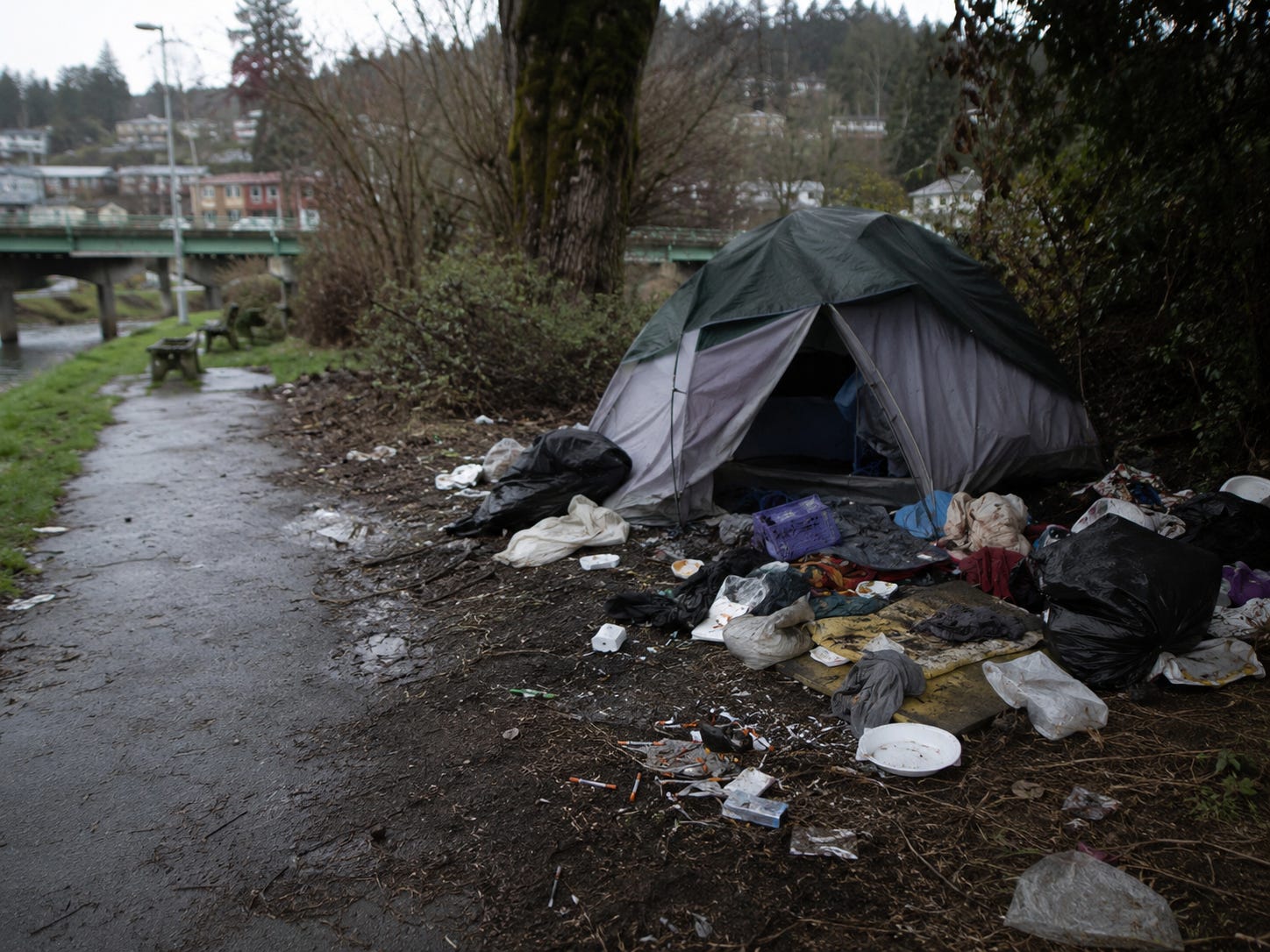
The legal question is no longer whether cities have any authority to regulate public camping. The question is whether Port Angeles has the will to use that authority wisely, humanely, and consistently.
Enforcement alone will not solve this. But no enforcement, no boundaries, and no priority zones will not solve it either.
That brings us back to the City’s role. Port Angeles cannot do everything. But it can do some things clearly and well.
Protecting businesses and neighborhoods is part of compassion
There is another piece we need to say more directly: protecting businesses, neighborhoods, workers, parks, trails, creeks, and public spaces is not a distraction from compassion. It is part of the City’s responsibility.
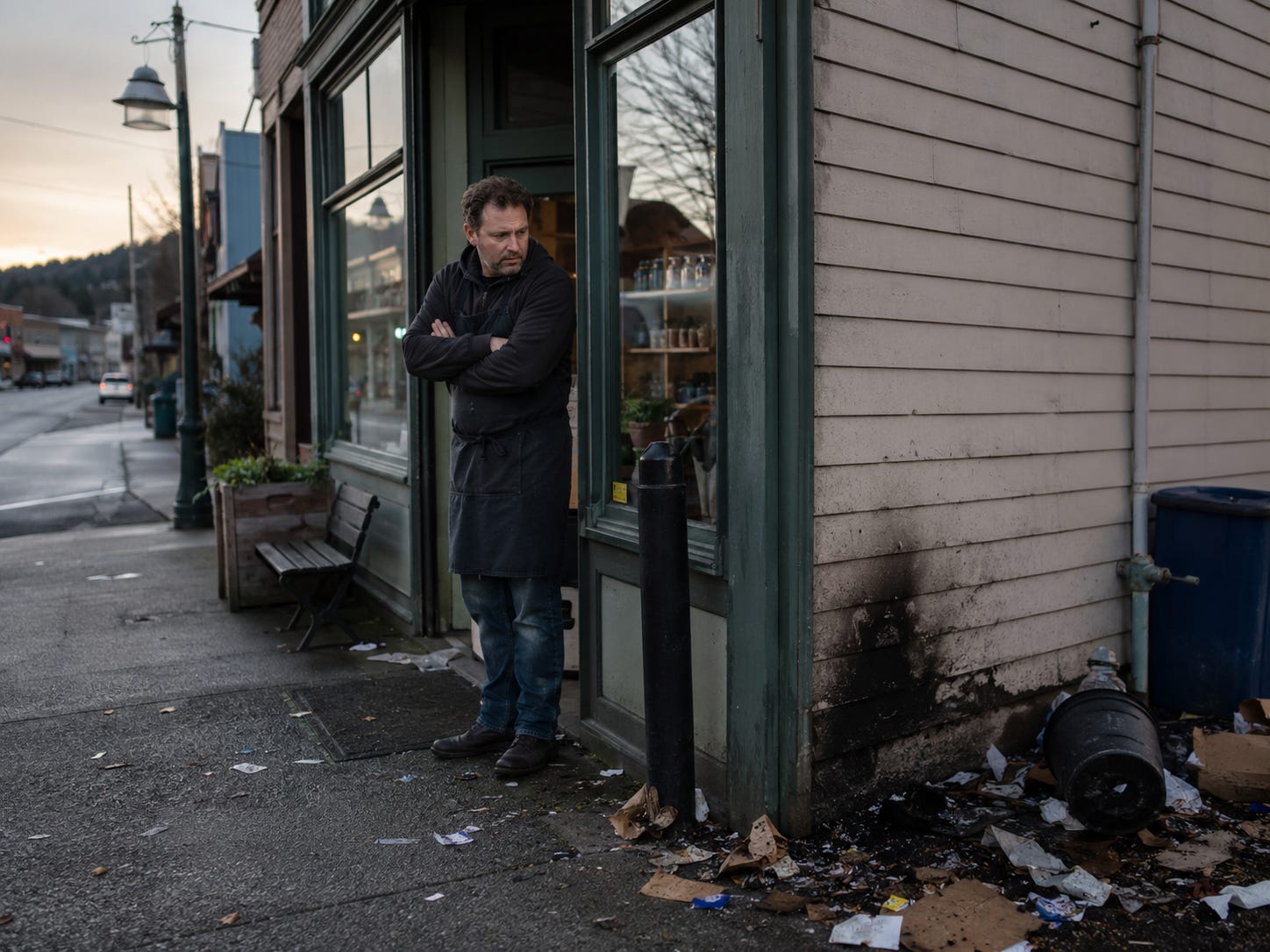
That does not mean criminalizing homelessness. Being homeless is not a crime, and it should not be treated like one. But behavior still matters. Theft, threats, assault, drug dealing, open-air drug use, fires, vandalism, obstruction, dumping, human waste, and environmental damage cannot be excused simply because they are connected to homelessness, addiction, or mental illness.
There is a difference between enforcing against a person’s status and enforcing against harmful conduct.
That distinction came through clearly in my conversations. Chief Brian Smith made the point that law enforcement does not deal with someone simply because they are unhoused. It gets involved when someone is doing something wrong, creating a public problem, or needs to be connected to help. Wendy Sisk made a related point from the service-provider side: accountability is not the enemy of compassion. Sometimes the work is walking beside people while they manage the consequences of their choices, not preventing every consequence from occurring.
That is the balance Port Angeles needs.
Best practices from other communities point in the same direction. Bellingham’s public encampment process, for example, includes reports entered into a shared database, site visits, evaluation based on public health, environmental and safety hazards, outreach, notice, scheduling, and cleanup. It prioritizes parks and rights of way and states that indiscriminate sweeps without notice are not conducted. Bellingham also frames its work as balancing public safety, property rights, and the well-being of people experiencing homelessness, substance use disorders, or behavioral health challenges, while still enforcing relevant codes and regulations.
That is the kind of posture Port Angeles should adopt: humane, lawful, clear, and firm.
Businesses and neighborhoods should not be left to solve this alone. A downtown employee cleaning up waste before opening, a homeowner dealing with theft from an alley, a parent avoiding a park, or a volunteer returning to the same encampment site week after week should not be treated as background noise. These are public impacts. They deserve a public response.
The City should identify repeat hot spots, track calls and cleanup costs, improve lighting and visibility where appropriate, use design to reduce opportunities for crime and disorder, and enforce basic rules consistently. Crime Prevention Through Environmental Design focuses on controlling access, improving visibility, defining ownership, and encouraging maintenance of territory. Washington’s Municipal Research and Services Center notes that downtown safety usually requires multiple strategies at once, including safe public-space design, maintenance and beautification, monitors or security staff, and other responders.
None of that replaces housing, treatment, outreach, or recovery support.
But housing, treatment, outreach, and recovery support also do not replace the need for clear rules.
A serious strategy should say two things at the same time: help will be offered, and harmful behavior will not be ignored. That is not cruelty. It is how a city protects the whole community while still leaving the door open for people to change direction.
Port Angeles has limited resources, so the City must know its lane
Port Angeles cannot be everything.
The City should not try to become Serenity House, Peninsula Behavioral Health, OPCC, OlyCAP, 4PA, the County, the State, a treatment provider, a housing authority, and a shelter operator all at once.
That would fail.
The City’s role should be narrower, clearer, and more disciplined.
Protect public spaces.
Protect businesses and neighborhoods.
Protect parks, trails, creeks, ravines, bluffs, shorelines, and the waterfront.
Set clear expectations around camping, fires, waste, obstruction, dumping, threatening behavior, illegal drug activity, and environmental damage.
Enforce laws and ordinances against harmful conduct consistently, especially in priority zones.
Coordinate with service providers, but do not duplicate them.
Support targeted projects that fill real gaps.
Measure outcomes.
Advocate hard to the County and State for detox, treatment, supportive housing, recovery housing, and behavioral-health capacity.
Use limited City dollars only where they produce measurable improvement.
That is not a lack of compassion. It is basic stewardship.
Once the City understands its lane, the next step is to act with focus.
What Port Angeles should do now
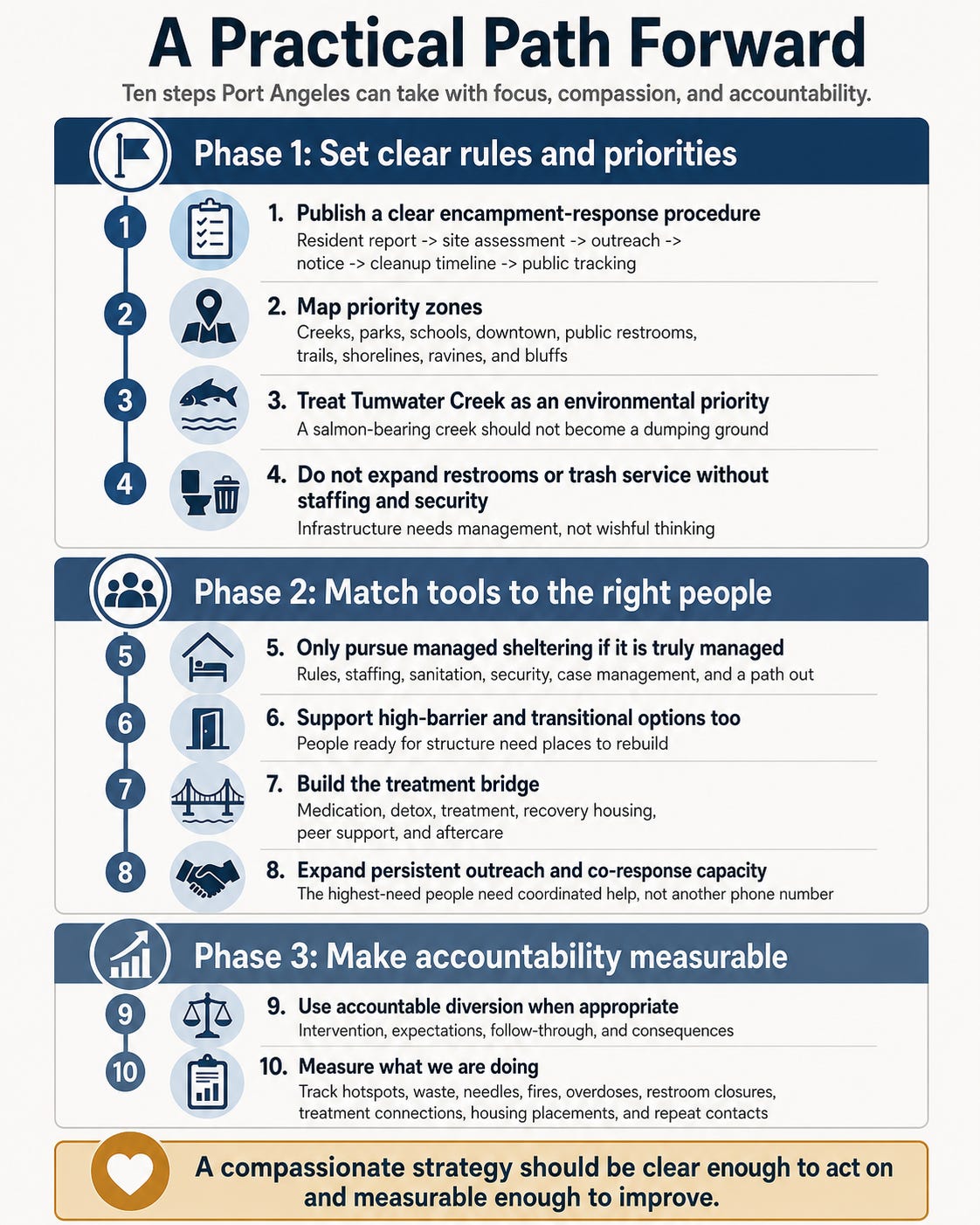
Here is the practical path I believe the City should take.
First, adopt and publish a clear encampment-response procedure. A resident report should trigger a predictable process: site assessment, risk level, outreach, notice, cleanup timeline, property handling, environmental review when needed, and public tracking. People should not feel like their reports go into a black hole.
Second, map priority zones and attach response expectations to them. Tumwater Creek, Peabody Creek, the Waterfront District, downtown business corridors, public restrooms, parks, trails, schools, ravines, bluffs, shorelines, and environmentally sensitive areas should not be treated the same as every other location. The City should say clearly which places require the fastest and firmest response, what conduct will trigger enforcement, and who is responsible for follow-up.
Third, treat Tumwater Creek as an environmental priority. This is not just a homelessness issue. It is a salmon-bearing creek and a public asset. Allowing waste, fires, encampments, and drug debris to accumulate there is a failure of environmental stewardship.
Fourth, do not expand restrooms and trash service without staffing and security. Bathrooms and trash cans may be necessary, but the City must stop pretending infrastructure manages itself. If we cannot maintain what we have, adding more without a management plan is irresponsible.
Fifth, only pursue managed sheltering if it is truly managed. Any sanctioned encampment, safe parking site, or temporary sheltering area must have rules, staffing, sanitation, fire restrictions, security, case management, data collection, neighborhood communication, and a path out. Otherwise, it should not be approved.
Sixth, support high-barrier and transitional options too. Not every program should be low barrier. People who are ready for sobriety, work, structure, and responsibility deserve a place to rebuild without being surrounded by active drug use. Touchstone Campus is one example of a tool aimed at that part of the spectrum.
Seventh, build the treatment bridge. Medication treatment, detox, residential treatment, outpatient care, recovery housing, peer support, and 90-day aftercare after jail, overdose, or treatment should be treated as one connected pathway. Medication can stabilize. It should lead somewhere.
Eighth, expand persistent outreach and co-response capacity for the highest-need people. A person who cannot navigate appointments, paperwork, or ordinary case management needs ongoing, coordinated help, not another phone number.
Ninth, use accountable diversion when appropriate. Low-level criminal behavior tied to addiction and mental illness should become an intervention point. But diversion must include expectations, follow-through, and consequences when people continue causing harm.
Tenth, measure what we are doing. Track encampment sites, repeat hotspots, tons of waste, needles collected, fire calls, overdose responses, restroom closures, cleanup costs, business and neighborhood complaints, enforcement actions, treatment connections, shelter exits, housing placements, and repeat contacts. If a program is working, show us. If it is not, change it.
Frustrated residents are not the enemy
There is a tendency in these debates to divide people into camps.
One side gets accused of being heartless.
The other gets accused of enabling chaos.
That is not helping us.
Most people I talk to are not cruel. They do not want people suffering outside. They do not want people dying of overdose. They do not want untreated mental illness abandoned to the street.
But they also do not want to be told that what they are seeing is not real.
They do not want to be told that fires, waste, theft, needles, vandalism, threats, and open-air drug use are just the cost of caring.
They do not want another study if the study becomes a substitute for action.
They want hope, but not denial.
They want compassion, but not permissiveness.
They want progress they can see.
That is reasonable.
People can be compassionate and still expect boundaries. They can be frustrated and still care deeply about the people who are suffering.
Real compassion is harder than slogans
There are two easy lies in this conversation.
The first is that people just need housing, and everything else will sort itself out.
The second is that people just need jail, and everything else will sort itself out.
Both are wrong.
Some people need housing. Some need treatment. Some need medication. Some need detox. Some need psychiatric care. Some need a structured transitional program. Some need a safe place to park. Some need a job and a second chance. Some need consequences. Some need all of the above, in the right order, over a long period of time.
That is why we need a toolbox, not a slogan.
Housing is a tool.
Treatment is a tool.
Medication is a tool.
Harm reduction is a tool.
Persistent outreach is a tool.
Accountable diversion is a tool.
High-barrier transitional housing is a tool.
Managed sheltering may be a tool.
Enforcement is a tool.
But every tool can do harm when used for the wrong job.
The work before us is to match the right tool to the right person, the right place, and the right problem.
The line we need to draw
Port Angeles does not have to choose between compassion and accountability. We need both.
Compassion without boundaries leaves vulnerable people suffering in tents, ravines, bathrooms, sidewalks, and creek beds. It leaves businesses and the public exasperated and frustrated. Accountability without compassion forgets that these are human beings, many of whom are sick, traumatized, addicted, disabled, or simply out of options.
The path forward is harder than either extreme.
Housing where housing is the problem.
Treatment where addiction and mental illness are the problem.
Structure where people are ready to rebuild.
Support where people are willing to engage.
Clear boundaries where public harm is occurring.
Protection for businesses, neighborhoods, workers, parks, creeks, and shared public spaces.
That is not cruelty.
That is what real compassion requires.
Clallam County Solutions exists because I believe this community is capable of better conversations and better outcomes. We have helpers. We have people doing difficult work every day. We have volunteers, outreach workers, police officers, firefighters, business owners, shelter staff, behavioral-health professionals, City employees, and neighbors trying to hold things together.
But helpers need a strategy.
They need clear expectations.
They need the City to draw lines that are fair, humane, and firm.
Port Angeles cannot simply compassion its way out of this if compassion means looking away from harm. We need compassion with backbone. We need accountability with humanity. We need a City Council willing to study what needs studying, but also willing to act where the facts are already clear.
The suffering on our streets is real.
The frustration in our community is real.
The damage to public spaces is real.
And the need for a better path is urgent.
Let’s build that path with honesty, courage, and respect.
Active dialogue and engagement with our readers is crucial. Writers on this platform are encouraged—and expected—to revisit their articles regularly, responding thoughtfully to readers’ questions and concerns.
We want conversations, not shouting matches. Therefore, comments will be reviewed regularly and are expected to adhere to these foundational guidelines:
Stay on Topic: Comments must relate directly to the article.
Respectfulness: Every comment should demonstrate respect toward authors, website management, and fellow commenters. Bullying, name-calling, or disrespectful behaviors will not be tolerated.
Constructive Dialogue: Political grandstanding is unwelcome here. While some discussions naturally involve political elements, the goal is to enhance understanding, clarify perspectives, and contribute constructively.
No Personal Attacks: As Theodore Roosevelt wisely said, it’s the person who is “actually in the arena” who deserves our respect. Criticism is welcome, but personal attacks are not.
Transparency: Any new guidelines needed as this platform evolves will prioritize civility, decency, and productive dialogue.
This is very well written. Unfortunately nuance and pragmatism are not a part of Port Angeles City Council’s skill set. I am going to add this to my calendar to re read one year from today. I suspect the problems will get worse - especially those service resistant that refuse to respect any rules.
I appreciate this article and your time on the matter. This is well done with very valid concerns and I believe viable answers. Thank you for your time.