


A Community Searching for Steady Ground
Public life today feels louder than ever, yet somehow less clear. Conversations about national politics are tense, and even local issues can split neighbors who share many of the same hopes for this place we call home. Many of us sense that something important has shifted. The extremes seem to speak the loudest, while the thoughtful middle, where real solutions tend to emerge, is harder to find.
In moments like this, a simple question rises to the surface: how do we lead and solve problems when everything around us feels pulled toward opposite poles?
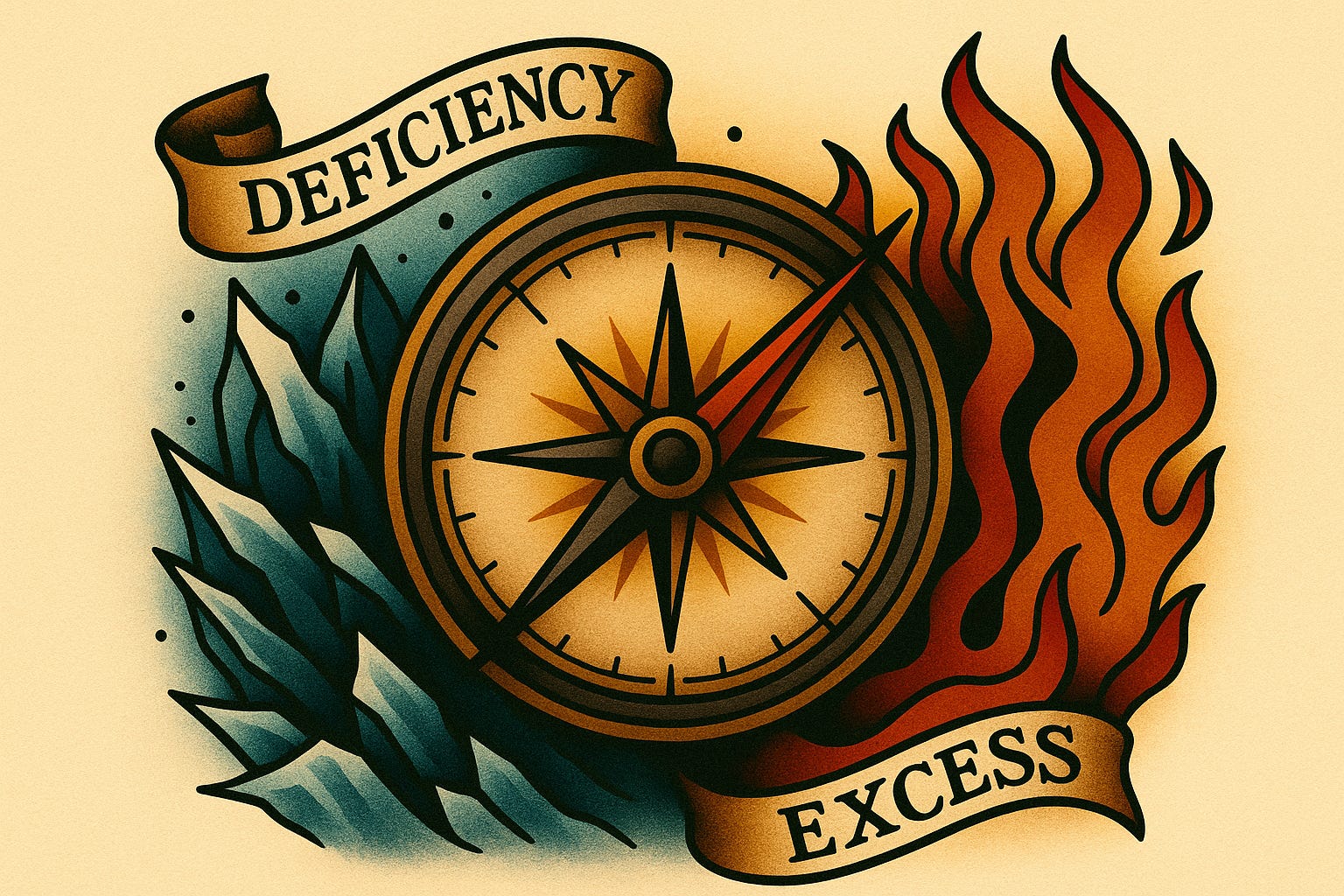
There is an ancient idea that offers surprising clarity. Aristotle described it as the Golden Mean, the belief that virtue exists in balance rather than in extremes. A modern illustration of this framework shows how each virtue sits between two distortions: one of deficiency and one of excess. It is a reminder that durable, practical answers almost never sit at the edges.
Seen through this perspective, the challenges we face—national division, strained local dialogue, and the complex issues shaping daily life in Clallam County—come into sharper focus. The Golden Mean offers a way to understand the forces pulling us apart and a guide for approaching issues like homelessness, growth, environmental stewardship, and long-term budgeting with clarity and balance.
If we want a healthier civic culture, we need more than arguments and more than slogans. We need a shared commitment to bringing our decisions back toward balance, where problem-solving, trust, and progress have a chance to grow. This is an invitation to explore what that could look like here at home.
Understanding the Virtue Continuum: A Framework for Modern Leadership
The Golden Mean offers a way to think about leadership and decision-making that feels especially relevant today. Aristotle taught that every virtue sits between two unhealthy opposites. One reflects too little of a quality we need. The other reflects too much. The balanced middle is not a compromise. It is the strongest and most constructive expression of that quality.
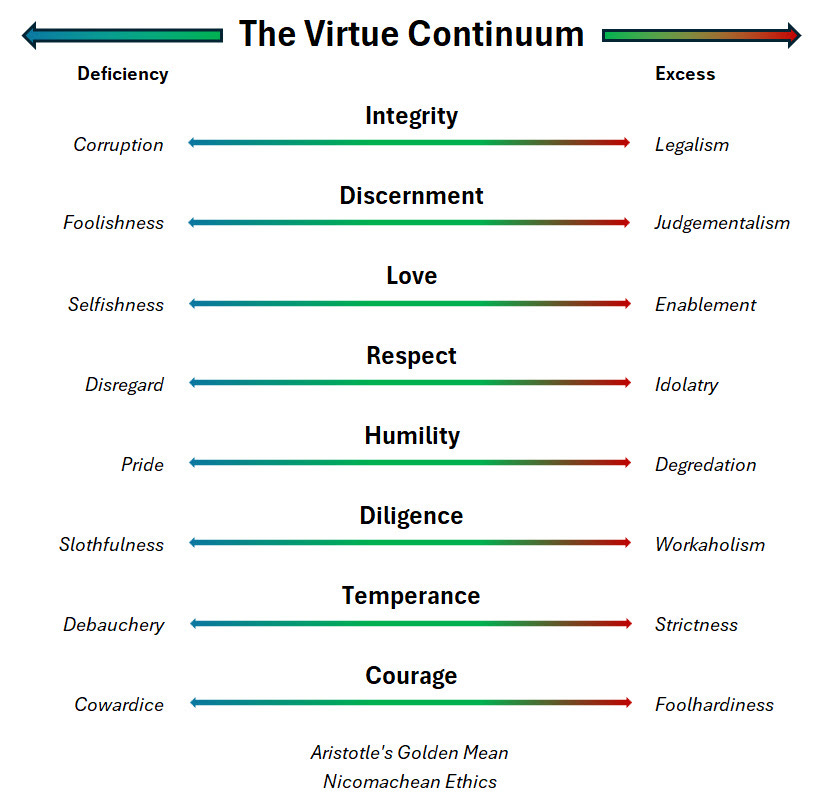
This graphic visualizes these continuums. Each set includes a deficiency on the left, a virtue in the center, and an excess on the right. Once we understand how these relationships work, we begin to see why extremes so often fail us and why thoughtful leadership requires holding tension rather than collapsing into simplicity.
Consider integrity, which rests between corruption and legalism.
Corruption abandons principle and undermines trust. Legalism, by contrast, becomes so rigid that it forgets context, compassion, and fairness. Integrity occupies the center, holding to core values while recognizing that real-life decisions demand judgment rather than simple rule-following.
Discernment follows a similar pattern.
On one side is foolishness, the failure to take information, risk, or consequence seriously. On the other is judgementalism, a swift and harsh certainty that shuts out understanding. Discernment listens, evaluates, and seeks truth without rushing to either naive acceptance or condemnation.
Love may seem like a personal virtue, but it has civic relevance as well.
Selfishness focuses only on personal comfort or fear. Enablement removes all expectations in the name of compassion. Love holds both dignity and accountability at once, which is especially important in conversations about homelessness, social services, and safety.
Temperance provides another useful lens.
Debauchery reflects a lack of restraint. Strictness swings too far in the opposite direction, sacrificing flexibility. Temperance encourages thoughtful limits while still allowing room for creativity and adaptation. It helps communities evaluate how much regulation is needed without drifting into overreach or neglect.
Finally, courage shows why balance is often the hardest place to stand.
Cowardice avoids necessary action. Foolhardiness ignores risk and reflection. Courage acknowledges the difficulty but chooses purposeful action. In civic life, it often takes courage to hold a balanced position when extremes on both sides insist on total alignment.
Together, these examples reveal an important truth. Extremes are easy. They offer emotional certainty and simple narratives. The balanced center requires more from us. It asks us to recognize nuance, consider competing values, and choose actions that support long-term community wellbeing rather than chase quick wins.
The Golden Mean does not call for timidity. It calls for wisdom. In leadership and civic life, this middle space is where trust is built, where collaboration becomes possible, and where practical solutions begin to take shape.
With this understanding in place, the patterns of our national political climate come into sharper focus. The same distortions that shift virtues off balance often drive the divisions we experience locally as well.
The Cost of Extremes in Today’s Political Climate
If the Golden Mean teaches that virtue lives between deficiency and excess, much of our modern political culture pushes us toward the edges instead. Public life increasingly rewards absolute certainty, quick judgments, and simplified narratives that divide issues into two incompatible camps. In this environment, nuance can feel suspect and moderation is often mistaken for weakness.
National politics illustrates this tendency clearly. Complex challenges are reduced to slogans. Voters are encouraged to choose between sharply opposed positions, even though most people hold a blend of values that do not fit neatly into a single category. Leaders face pressure to offer definitive answers rather than thoughtful ones, and the loudest voices often overshadow the most constructive.
This shapes how people see one another. When every disagreement signals allegiance to “the other side,” trust erodes. It becomes easier to assign motives than to explore perspectives. The patience and curiosity required for real understanding start to disappear, replaced by defensiveness and suspicion.
Although these patterns originate nationally, they inevitably filter into local life. Conversations about zoning, homelessness, housing density, or city budgeting sometimes borrow assumptions from national debates, even when local issues depend on entirely different facts. Instead of wrestling with the practical realities of Clallam County, discussions can drift into familiar ideological grooves that do little to move solutions forward.
The cost of this is significant. Collaboration becomes harder. Public meetings grow tense. Leaders may feel pressure to signal loyalty to one side rather than pursue decisions shaped by local context. And residents who hold thoughtful or mixed views may slowly withdraw, believing there is no real space for nuance.
This is where the Golden Mean becomes more than a philosophical framework. It becomes a lens for understanding how our civic life drifts off balance. Each of the virtues described earlier has a distorted form that shows up in today’s politics. Integrity falters when we swing between rigid rule enforcement and dismissing rules altogether. Discernment weakens when assumptions replace understanding. Compassion becomes harder to practice when the only options offered are self-protection or boundary-free permissiveness. Temperance is strained by a culture that amplifies volatility. Courage becomes more difficult when thoughtful positions are attacked from multiple sides.
When our public life is pulled to the edges, even our best virtues struggle to hold their shape.
Recognizing these patterns matters because local communities are not powerless. We can choose a different civic culture. We can reward leaders who take time to understand context, who communicate openly, and who do not confuse volume with effectiveness. We can make room for disagreement without hostility.
As we turn toward the real challenges facing Clallam County, this mindset becomes essential. Homelessness, housing, environmental protection, infrastructure, and fiscal responsibility are not problems that yield to extremes. They require the steady approach that balances competing needs and works toward long-term wellbeing.
The path forward is not found at either pole. It takes shape in the thoughtful middle, where people commit to understanding one another and building solutions together. With that perspective, our local challenges come into clearer focus.
Applying the Golden Mean to Local Challenges in Clallam County
The Golden Mean becomes most powerful when we apply it to the situations that affect people’s daily lives. Clallam County faces challenges that influence everything from housing stability to environmental health to long-term economic vitality. These issues rarely fit into tidy ideological categories. They involve competing values, limited resources, and the ongoing task of balancing individual needs with community wellbeing.
When tensions rise, public debate often drifts toward the extremes: one side pushing too little of a needed value, the other pushing too much. Real progress begins when we step back from those poles and take the wider picture into account.
We can see this clearly across several of our most important local conversations.
Homelessness: Between Enablement and Punishment
Public discussion around homelessness often settles into two predictable camps. One emphasizes compassion so heavily that expectations and accountability fade. The other prioritizes order and safety to such a degree that people experiencing homelessness are treated mostly as problems to remove rather than individuals trying to regain stability.
Both viewpoints contain something true. People need access to services, and communities need public safety. But neither extreme produces meaningful improvement. Approaches rooted only in compassion can unintentionally sustain harmful cycles. Approaches rooted only in enforcement often overlook root causes and make it harder for people to access the help they need.
Enablement is not compassion, but consequences without supportive pathways
cannot lead to sustainable positive outcomes either.
Balanced communities take a different approach. They ensure that services exist but pair them with clear expectations and pathways forward. They insist that public safety and human dignity are not competing values. They recognize that long-term progress comes from combining support with responsibility. This middle-ground model is not designed to satisfy ideology. It is designed to produce real outcomes.
Housing and Environmental Stewardship: Between Stagnation and Overreach
Clallam County is defined by its natural beauty, yet shaped by the urgent need for more attainable housing. These are two deeply held community priorities, and too often the debate frames them as mutually exclusive.
On one end is the instinct to restrict development so heavily that growth becomes nearly impossible. On the other is the push to build quickly and expansively, risking strain on infrastructure and sensitive ecosystems. Each reflects legitimate concerns. Each, taken too far, carries real consequences: stagnation on one side, overreach on the other.
Balanced leadership recognizes that environmental stewardship and housing availability must work together. When applied thoughtfully, tools like thoughtful zoning, strategic density, infill development, modern environmental standards, and long-range planning can complement one another rather than collide. Communities that plan well can grow responsibly and preserve what makes this region special.
Finding this balance requires the courage to look beyond slogans and examine real data, as well as examples from similar communities. Sustainable growth is not about choosing one value over another. It is about integrating multiple values in ways that strengthen families, employers, and ecosystems.
Fiscal Responsibility: Between Austerity and Excess
Budget discussions reveal how difficult it is to balance community expectations with economic realities. Residents want dependable roads, strong emergency services, maintained utilities, and safe public spaces. These are foundational needs.
At the same time, many households feel the pressure of rising costs. Taxes, utilities, and fees accumulate quickly, especially for those already struggling. When local governments ask more of their citizens financially, they carry a responsibility to provide more in return: clearer communication, greater transparency, and disciplined stewardship. Investments must be justified not only in numbers but in outcomes.
Here again, extremes fall short. Deep cuts may offer short-term relief but undermine long-term health and stability. Broad expansions of spending may address immediate needs but can create structural risks and erode public trust.
Balanced fiscal stewardship recognizes that strong communities require strategic investment, but it insists that those investments be smart, prioritized, and measurable. It asks leaders to articulate why certain expenditures matter and how they serve long-term goals. This approach is not partisan. It is practical.
Across these examples, the pattern is clear. Extremes offer clarity but not solutions. They can simplify debate while distorting reality. The Golden Mean invites a different posture: one that acknowledges competing values, weighs trade-offs honestly, and builds decisions that strengthen the entire community.
Clallam County does not need to choose between compassion or accountability, growth or preservation, or investment or restraint. What it needs is the steady middle ground where trust grows, progress takes shape, and long-term wellbeing becomes possible.
Leading and Building Together on the Middle Path
Balanced leadership is not an abstract ideal. It shows up in the decisions leaders make every day and in the way communities respond to one another in moments of tension or change. When people choose balance over extremes, they create space for clarity, collaboration, and long-term progress. The Golden Mean becomes not just a philosophical framework, but a practical guide for civic life in Clallam County.
We are at a moment that calls for this approach. Economic pressures, housing shortages, infrastructure needs, behavioral health challenges, and the rising cost of living all place real demands on local systems. National political polarization adds another layer of difficulty, often pulling local conversations into unproductive patterns borrowed from elsewhere. Leadership rooted in extremes may generate attention, but it rarely produces durable solutions. What our community needs is steadiness: the capacity to navigate competing priorities without collapsing into oversimplified answers.
Balanced leadership begins with integrity and clear communication. It means being transparent about decisions, the reasoning behind them, and the long-term goals they serve. In a small community where trust is both essential and fragile, this kind of openness forms the foundation of effective public life.
It also requires discernment. Local issues are rarely simple, and leaders must be willing to understand problems in their full context rather than rely on ideological shortcuts. This includes listening to residents with different experiences, weighing evidence carefully, and recognizing that people can disagree in good faith while still caring deeply about the community.
The hardest work in public life is holding the middle,
yet that is where the most durable solutions take root.
Compassion adds another dimension. Policy choices affect real people, and acknowledging that human impact matters. But compassion must work alongside accountability if communities want lasting progress. The most effective local approaches pair help with expectations, support with standards, understanding with responsibility.
Temperance provides the steadiness needed to navigate conflict and pressure. It allows leaders to stay focused on long-term outcomes rather than chasing short-term victories. It encourages patience when decisions are complex, and restraint when the political climate rewards overreaction.
Above all, balanced leadership requires courage. Not the theatrical kind that seeks applause, and not the reckless kind that ignores risk. Courage in public life is often quieter. It appears in the willingness to make decisions that serve the long-term health of the community even when those decisions are not politically convenient. It shows up when leaders speak honestly about trade-offs, resist the gravitational pull of extremes, and stay committed to solutions that reflect the full complexity of the situation.
Yet leadership alone cannot build the civic culture we need. A thriving community depends on residents who bring these same qualities into their everyday interactions. That means approaching public dialogue with curiosity rather than assumption. It means creating space for disagreement without turning it into division. It means recognizing that priorities such as environmental stewardship, housing, safety, economic vitality, and fiscal discipline are not competing agendas. They are shared responsibilities that must be woven together if the community is to flourish.
When we engage one another this way, the middle path becomes visible again. It looks less like indecision and more like the place where workable solutions take shape. It invites people to look at the full problem, not just one piece of it. It reminds us that progress rarely comes from choosing one extreme over another, but from integrating values that matter on both sides of an issue.
Clallam County already has the ingredients for this kind of civic life. We have residents who care deeply about this region, who bring different strengths and experiences, and who want their community to succeed. Balanced leadership can model a healthier approach. A balanced community can bring that model to life.
Conclusion: Choosing the Path Where Solutions Live
Clallam County stands at a moment shaped by real challenges but also real opportunity. The pressures we face—economic, social, environmental, and civic—will not be solved by doubling down on extremes or by treating disagreement as a dividing line. They will be solved by people who are willing to look past the noise, focus on what matters, and work together with steadiness and purpose.
Most of us are not searching for perfect ideological alignment. We are searching for solutions that make our community safer, healthier, and more hopeful. We want reliable infrastructure, attainable housing, strong local businesses, and public systems that function with transparency and discipline. We want a civic culture where disagreement is part of the process, not a barrier to participation.
The path to that future lies in the balanced middle. It’s the place where integrity and courage can actually shape decisions. It’s where compassion and accountability work in tandem. It’s where competing priorities can coexist instead of collide. And it’s where residents and leaders alike can focus on long-term wellbeing rather than short-term wins.
Clallam County has all the ingredients it needs to move in this direction: people who care, people who listen, and people who want to build a stronger community. If we choose balance over extremes and curiosity over assumption, we can create a civic culture that reflects the best of who we are.
The loudest voices will not determine our future. The steady work of people committed to the middle path will. That is where solutions take root, and where a more connected, resilient Clallam County can grow.
Active dialogue and engagement with our readers is crucial. Writers on this platform are encouraged—and expected—to revisit their articles regularly, responding thoughtfully to readers’ questions and concerns.
We want conversations, not shouting matches. Therefore, comments will be reviewed regularly and are expected to adhere to these foundational guidelines:
Stay on Topic: Comments must relate directly to the article.
Respectfulness: Every comment should demonstrate respect toward authors, website management, and fellow commenters. Bullying, name-calling, or disrespectful behaviors will not be tolerated.
Constructive Dialogue: Political grandstanding is unwelcome here. While some discussions naturally involve political elements, the goal is to enhance understanding, clarify perspectives, and contribute constructively.
No Personal Attacks: As Theodore Roosevelt wisely said, it’s the person who is “actually in the arena” who deserves our respect. Criticism is welcome, but personal attacks are not.
Transparency: Any new guidelines needed as this platform evolves will prioritize civility, decency, and productive dialogue.